
Logarithm TheoremPythagorean Theorem
`-=[]⟨⟩\;',./~!@#$%^&*()_+{}|:"<>? 𝑎𝑏𝑐𝑑𝑒𝑓𝑔ℎ𝑖𝑗𝑘𝑙𝑚𝑛𝑜𝑝𝑞𝑟𝑠𝑡𝑢𝑣𝑤𝑥𝑦𝑧
Å − × ⋅∓±∘꞊﹦∗∙ ℯ 𝔸𝔹ℂ𝔻𝔼𝔽𝔾ℍ𝕀𝕁𝕂𝕃𝕄ℕ𝕆ℙℚℝ𝕊𝕋𝕌𝕍𝕎𝕏𝕐ℤ𝐴𝐵𝐶𝐷𝐸𝐹𝐺𝐻𝐼𝐽𝐾𝐿𝑀𝑁𝑂𝑃𝑄𝑅𝑆𝑇𝑈𝑉𝑊𝑋𝑌𝑍
∼∽∾≁≂≃≄≅≆≇≈≉≌≐≠≡ ≤≥≦≧≨≩≪≫
∈∉∊∋∌∍ ⊂⊃⊄⊅⊆⊇ 𝛼𝛽𝛾𝛿𝜀𝜁𝜂𝜃𝜄𝜅𝜆𝜇𝜈𝜉𝜊𝜋𝜌𝜎𝜏𝜐𝜑𝜒𝜓𝜔
∀∂∃∅⦰∆∇∎∞∝∴∵ ∏∐∑⋀⋁⋂⋃ ∧∨∩∪
∫∬∭∮∯∰∱∲∳ ∥⋮⋯⋰⋱ ‖ ′ ″ ‴ ⁄ ⁗ ʹ ʺ ‵ ‶ ‷
﹁ ﹂ ﹃ ﹄ ︹ ︺ ︻ ︼ ︗ ︘ ︿ ﹀ ︽ ︾ ﹇ ﹈ ︷ ︸ ⏜ ⏝ ⎴ ⎵ ⏞ ⏟ ⏠ ⏡
←↑→↓↤↦↥↧↔↕↖↗↘↙▲▼◀▶↺↻⟲⟳ ↼↽↾↿⇀⇁⇂⇃⇄⇅⇆⇇ ⇐⇑⇒⇓⇔⇌⇍⇏⇕⇖⇗⇘⇙⇙⇳⥢⥣⥤⥥⥦⥧⥨⥩⥪⥫⥬⥭⥮⥯
Draft for Information Only
ContentTotal Number of Possible Arrangement
Total Number of Possible ArrangementPascal's FormulaPascal's Formula, also called Pascal's Rule is a combinatiorial identity.
Binomial ExpansionBinomial Expansion is an algebraic expressions of two terms.
Pascal's TrianglePascal's triangle is a triangular array of the binomial coefficients. 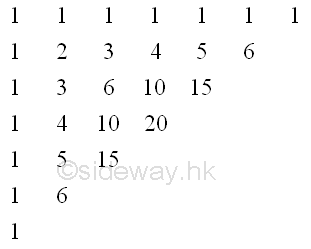
Multinomial ExpansionBinomials are just a special case of a larger class of expressions called multinomials expressions with more than one term. The expresion (𝑎+𝑏+𝑐) is a trinomial. Number of Subsets of a SetFor a 10 elements set {1, 2, 3, 4, 5, 6, 7, 8, 9, 10}, there are 2^10 possible sets. In mathematics of sets, This is not a proper subset of the original set, because it contains the entire set. All other subsets, including the empty set, are considered proper subsets. Therefore, there are 2^10−1 proper subsets of {1, 2, 3, 4, 5, 6, 7, 8, 9, 10}. More generally, there are 2^𝑛 subsets of an 𝑛-elemnet set, and 2^𝑛-1 proper subsets of that 𝑛n-element set.Total Possible ArrangementsExample of a binomial birth-order arrangements. For a family with 𝑛 children, 𝑟 of them sons, there are 𝐶(𝑛,𝑟) different birth order arrangements.
The problem of total possible arrangements can be solved by relating the combinatorial representation to the binomial expransion.
Two equations can be equated by letting 𝑎 and 𝑏 both equal 1,
Therefore Total Possible ArrangementsThe total number of possible ways to arrange 𝑛 objects with first type of object from 0 to 𝑛 and second type of object from 𝑛 to 0 is
Or
Total Possible ArrangementsGiven 𝑛 objects of 𝑟 different types, then there are 𝑟𝑛 total possible ways to arrange the 𝑛 objects given all possible ways to group the 𝑟 types.
Finite DifferencesPascal's Triangle ©sideway ID: 190500011 Last Updated: 5/11/2019 Revision: 0 Ref:  References
Latest Updated Links
  Nu Html Checker Nu Html Checker  53 53  na na  na na |
 Home 5 Business Management HBR 3 Information Recreation Hobbies 9 Culture Chinese 1097 English 339 Travel 82 Reference 79 Hardware 57 Computer Hardware 263 Software Application 213 Digitization 37 Latex 52 Manim 205 KB 1 Numeric 19 Programming Web 290 Unicode 504 HTML 66 CSS 65 Selector 1 SVG 46 ASP.NET 270 OS 447 MS Windows DeskTop 7 Python 72 Knowledge Mathematics Formulas 8 Set 1 Logic 1 Algebra 84 Number Theory 207 Trigonometry 31 Geometry 34 Calculus 67 Engineering Tables 8 Mechanical Rigid Bodies Statics 92 Dynamics 37 Fluid 5 Control Acoustics 19 Natural Sciences Matter 1 Electric 27 Biology 1 |
Copyright © 2000-2026 Sideway . All rights reserved Disclaimers last modified on 06 September 2019
